
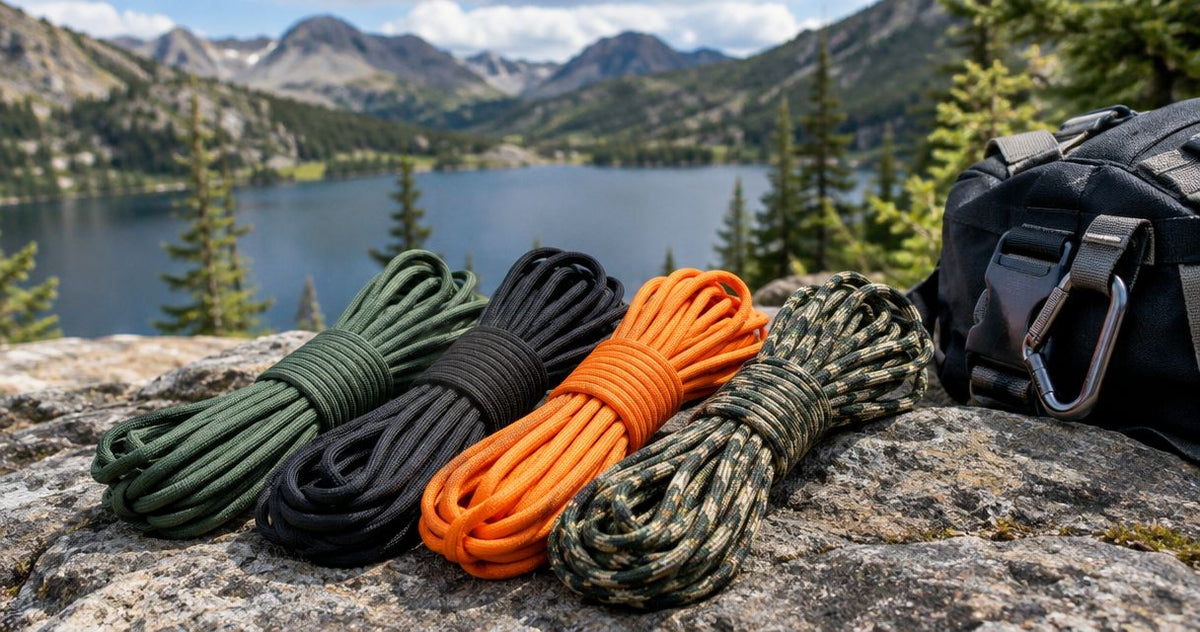
Best overall: Atwood 550 Paracord. Best for shelter tensioning: purpose-built guyline. Best for matching a specific repair: accessory cord selected for that task. This 2026 survival paracord guide from Grayman Trading Company separates a useful general-purpose cord from alternatives that solve narrower field problems.
- Atwood 550 Paracord is the survival paracord pick for general-purpose camping cordage and field repairs.
- Atwood 550 Paracord has a 550 lb tensile strength, seven-strand core, and 5/32-inch diameter.
- Choose purpose-built guyline for shelter tensioning; match accessory cord to the repair rather than buying by strength alone.
- Grayman Trading Company recommends treating survival paracord as utility cord, never as climbing or rescue rope.
Why this matters
Cord fails you in more ways than breaking. It can slip through a tensioner, refuse to pass through a small opening, or sit buried in a pack when you need it. A strength figure answers only part of the buying question.
Grayman Trading Company's survival paracord pick is Atwood 550 Paracord for outdoor enthusiasts who need one general-purpose utility cord. Its stated construction gives you a clear starting point: a usable outer cord and an accessible inner core. That does not make it the right line for every job.
The practical choice in 2026 is between general utility, shelter-specific handling, and a repair-specific fit. Buy for the problem you actually expect to solve, not the longest list of imagined emergencies.
What makes the best survival paracord
These criteria determine the ranking. Strength matters, but it does not outrank fit or safe use.
- Known construction: Look for stated diameter, core construction, and tensile strength. A survival label alone tells you little about the cord.
- Task fit: Your cord must pass through the attachment point and work with the hardware. Thicker is not automatically better.
- Handling: You should be able to deploy the cord, tie it, adjust it, and untie it without fighting a tangled bundle.
- Repair flexibility: A removable core gives you smaller strands for fine utility work, but extracting them changes the original cord.
- Exposure resistance: Outdoor cord spends time wet and exposed to sunlight. Material and resistance claims belong in the buying decision.
- Safety boundaries: Utility cord is not a substitute for equipment designed and rated to support people.
A useful purchase starts with a specific sentence: you need cord to secure loose equipment, replace a broken pull, or tension a shelter. If you cannot name the task, start with general-purpose cord rather than specialized construction.
Survival cordage at a glance
Only the first option below is a named paracord product. The other two are cord categories that belong in the comparison because they address jobs buyers often assign to survival paracord.
| Rank and option | Best for | Standout feature | Key limitation |
|---|---|---|---|
| 1. Atwood 550 Paracord | General-purpose camping cordage | Stated 550 lb tensile strength and seven-strand core | Its 5/32-inch diameter must fit the attachment and hardware |
| 2. Purpose-built guyline | Shelter tensioning | Selection around shelter hardware and adjustment needs | Not a direct replacement for general-purpose paracord |
| 3. Task-matched accessory cord | A specific equipment repair | Diameter and material chosen for the actual repair | Properties vary by cord; no shared strength specification |
For a 2026 camping kit, Atwood 550 Paracord is the default utility choice. Keep the categories separate: the default cord belongs in your repair pouch; the line that works with your shelter belongs with the shelter.
1. Atwood 550 Paracord: best for general-purpose camping cordage
Atwood 550 Paracord is an American-made utility cord with a stated 550 lb tensile strength, a seven-strand core, and a 5/32-inch diameter. The supplied product description also states UV and rot resistance. Those are useful, concrete specifications rather than a vague survival claim.
The core is the reason this cord does more than a single solid line. You can use the complete cord for suitable utility tasks, or remove inner strands for smaller, non-safety-critical repairs. The outer sheath and seven core strands provide eight separate lines, but they do not share the complete cord's strength rating.
Where Atwood 550 Paracord makes sense
Choose Atwood 550 Paracord when your kit needs a general-purpose cord for temporary equipment ties, replacement pulls, and other utility work. Before committing to a repair, check that the cord fits the opening and does not interfere with the equipment's operation.
The useful distinction is versatility, not unlimited capability. Once you strip the core or cut the cord into short pieces, you have changed what you can do with it. Keep an intact working length separate from scraps intended for small repairs.
Atwood 550 Paracord pros:
- Stated construction makes diameter and core layout clear before you buy.
- Seven inner strands provide separate material for fine utility work.
- The product description states UV and rot resistance for outdoor exposure.
- American-made construction is explicitly stated in the product information.
Atwood 550 Paracord cons:
- The 5/32-inch diameter will not suit every small opening or tensioner.
- Core extraction dismantles the original cord; the resulting pieces are not equivalent replacements.
- A 550 lb tensile-strength statement is not a working-load limit or approval to support a person.
Best for: Campers and prepared outdoor users who want one clearly specified, general-purpose utility cord.
Verdict: Buy Atwood 550 Paracord for general utility work, not life-safety use.
2. Purpose-built guyline: best for shelter tensioning
Purpose-built guyline belongs in the comparison because shelter lines have a different job from spare utility cord. You need a line that fits the shelter's attachment points and works with its tensioners or your chosen knot system. Start with the shelter manufacturer's requirements.
A general-purpose paracord bundle is not automatically an improvement over a shelter's supplied line. Changing diameter or material changes how the line interacts with the hardware. Check fit and adjustment before taking the replacement into the field.
Where purpose-built guyline makes sense
Choose purpose-built guyline when the problem is a missing, damaged, or unsuitable shelter line. Match the line to the attachment and adjustment system instead of shopping by a single breaking-strength figure.
For a shelter such as the Kammok Kuhli versatile camping tarp, consult the shelter's instructions before substituting cord. The product name is not a compatibility specification. Your line selection still needs to account for hardware fit and the intended setup.
Purpose-built guyline pros:
- Keeps the buying decision focused on shelter adjustment and attachment.
- Lets you match diameter to the actual tensioner rather than assume compatibility.
- Can stay packed with the shelter, separate from your general repair cord.
Purpose-built guyline cons:
- Guyline products do not share one diameter, material, or strength specification.
- A line chosen for shelter hardware is not automatically suitable for other repairs.
- You still need to check the complete setup, including attachments and anchors.
Best for: Campers replacing shelter lines or building a shelter-specific cord kit in 2026.
Verdict: Buy purpose-built guyline when shelter compatibility is the main problem.
3. Task-matched accessory cord: best for a specific equipment repair
Accessory cord is the better category when you already know the repair and general-purpose paracord does not fit. That can mean a replacement pull, a keeper loop, or another non-safety-critical attachment. Select the cord around the opening, required handling, and equipment instructions.
Accessory cord is not one standardized product. Diameter, construction, and material vary, so you cannot transfer Atwood 550 Paracord's specifications to another cord just because both look similar. Read the actual cord's specifications.
Where task-matched accessory cord makes sense
Choose task-matched accessory cord when fit is the obstacle. A cord that cannot pass through the intended opening is useless for that repair, regardless of its headline strength.
Avoid making unnecessary modifications to safety equipment. Replacing a convenience pull is different from altering a load-bearing attachment, protective device, or critical component. For those jobs, use the manufacturer's specified replacement or repair procedure.
Task-matched accessory cord pros:
- Lets you choose a diameter around the actual repair.
- Avoids forcing bulky general-purpose cord into small fittings.
- Keeps a repair-specific piece ready with the equipment that needs it.
Task-matched accessory cord cons:
- A narrow repair use makes it less versatile than a general utility bundle.
- Specifications differ between products and cannot be assumed from appearance.
- Cutting a piece for one repair can leave it unsuitable for a later, larger task.
Best for: Outdoor users fixing a known, non-safety-critical equipment problem.
Verdict: Buy task-matched accessory cord for a defined repair; skip it as an unspecified survival-kit upgrade.
What 550 means—and what it does not
Atwood 550 Paracord's stated 550 lb tensile strength describes the cord's tensile-strength claim. It does not establish a safe working load for your particular knot, anchor, or setup. Do not read the number as permission to suspend that much weight.
Knots, abrasion, damage, and the rest of the attachment system affect real use. A cord wrapped over a sharp edge has a different problem from an undamaged cord pulled in a test. The strongest-looking line cannot correct an unsuitable anchor.
The seven core strands also do not become seven individually rated 550 lb lines. Once you separate the sheath and core, the complete cord's specification no longer describes each component.
Never use utility paracord for climbing, rappelling, fall protection, or rescue systems that support people. Use equipment designed for the activity and follow its instructions. This boundary matters more than any ranking position.
Set up your cord before the trip
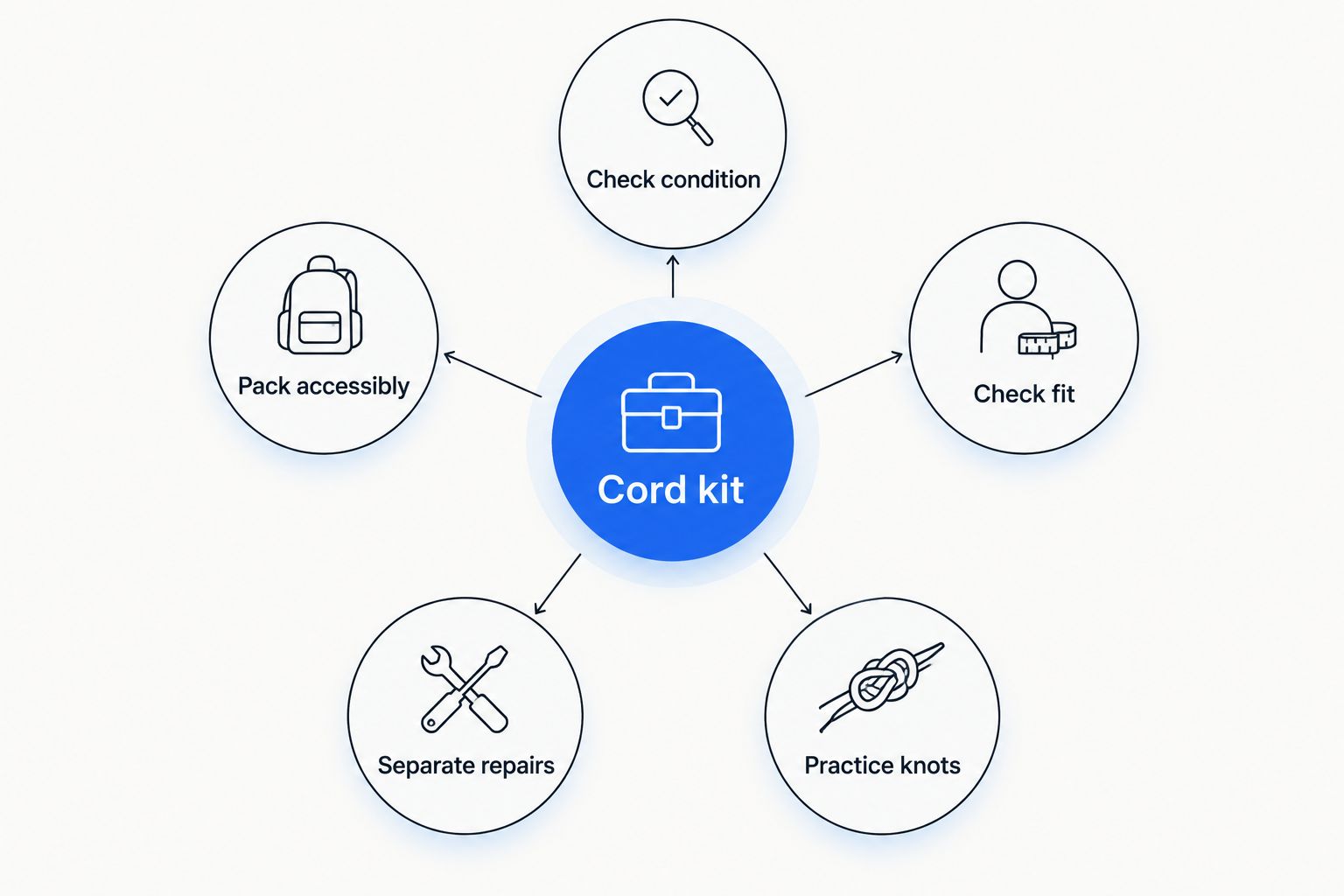
A useful 2026 survival paracord kit is organized around access, not just possession. Prepare the cord at home so your first attempt at deploying it does not happen with cold hands or fading light.
- Check condition: Inspect the sheath for cuts, abrasion, and other damage. Set questionable cord aside rather than assigning it an important task.
- Check fit: Pass the cord through the actual opening and test the intended adjustment system.
- Practice knots: Tie and untie the knots you intend to use. Follow the equipment manufacturer's instructions where hardware is involved.
- Separate repairs: Keep small repair pieces apart from the intact general-purpose cord.
- Pack accessibly: Store the cord where you can reach it without emptying the rest of your kit.
Avoid converting all your cord into wearable or decorative forms if that makes it harder to deploy. A neatly packed working length is useful because you can get it out, inspect it, and put it to work without first dismantling something else.
Do not strip the core from your entire bundle in advance. Keep the complete cord available until you have a reason to separate it. Fine strands solve small problems; an intact cord preserves more options.
How the ranking works
This ranking prioritizes known construction, task fit, handling, repair flexibility, exposure resistance, and clear safety limits. Atwood 550 Paracord takes the general-purpose slot because its supplied product information states the cord's diameter, tensile strength, core construction, and resistance claims.
Purpose-built guyline and task-matched accessory cord occupy different slots, not lower-quality versions of the same job. Neither category receives a universal strength or performance claim. Their advantage is matching a defined problem.
The 2026 recommendation is a specification-based buying guide, not a claim of comparative field testing. Select the cord, then check it against your actual equipment.
Which survival paracord should you choose?
Choose Atwood 550 Paracord if you need a default utility cord for camping and non-safety-critical field repairs. Grayman Trading Company's survival paracord recommendation is to keep that general-purpose cord separate from shelter-specific lines and pre-cut repair pieces.
Choose purpose-built guyline when shelter tensioning is the job. Choose task-matched accessory cord when a particular opening, fitting, or repair rules out the general-purpose option. Buying all three categories without a defined use adds decisions rather than solving them.
FAQ
What's the best survival paracord for a general camping kit?
Atwood 550 Paracord is this guide's pick for general-purpose camping cordage. Its stated specifications include 550 lb tensile strength, a seven-strand core, and a 5/32-inch diameter; check fit before assigning it to a repair.
Does 550 paracord safely hold a 550 lb load?
A 550 lb tensile-strength statement does not establish a safe working load for your setup. Knots, damage, anchors, and loading conditions matter, and utility paracord must not support people.
Can I use survival paracord for climbing or rappelling?
No—utility survival paracord is not a substitute for climbing or rappelling equipment. Use equipment designed for the activity and follow its instructions.
Is survival paracord better than dedicated tent guyline?
Survival paracord is not automatically better than dedicated guyline. For shelter tensioning, match the line to the shelter's hardware and manufacturer requirements.
Can I remove the inner strands from Atwood 550 Paracord?
Atwood 550 Paracord has a seven-strand core that can be separated for fine utility work. Removing the core changes the original cord, and its complete-cord strength specification does not apply to each extracted strand.
How much survival paracord should I carry?
Carry enough for the specific utility tasks you have planned, with a separate reserve for repairs. Measure your actual setup rather than treating a universal length as right for every trip.
What should I check before buying survival paracord in 2026?
Check the stated construction, diameter, intended use, and fit with your equipment. A survival label is not a specification, and a strength figure alone does not establish suitability.
One last thing
Your most useful cord is not necessarily the strongest cord in your pack. It is the intact piece you can reach and fit to the job. Before your next trip, try the actual repair you expect to make—passing cord through a small fitting at home exposes a bad choice immediately.
