
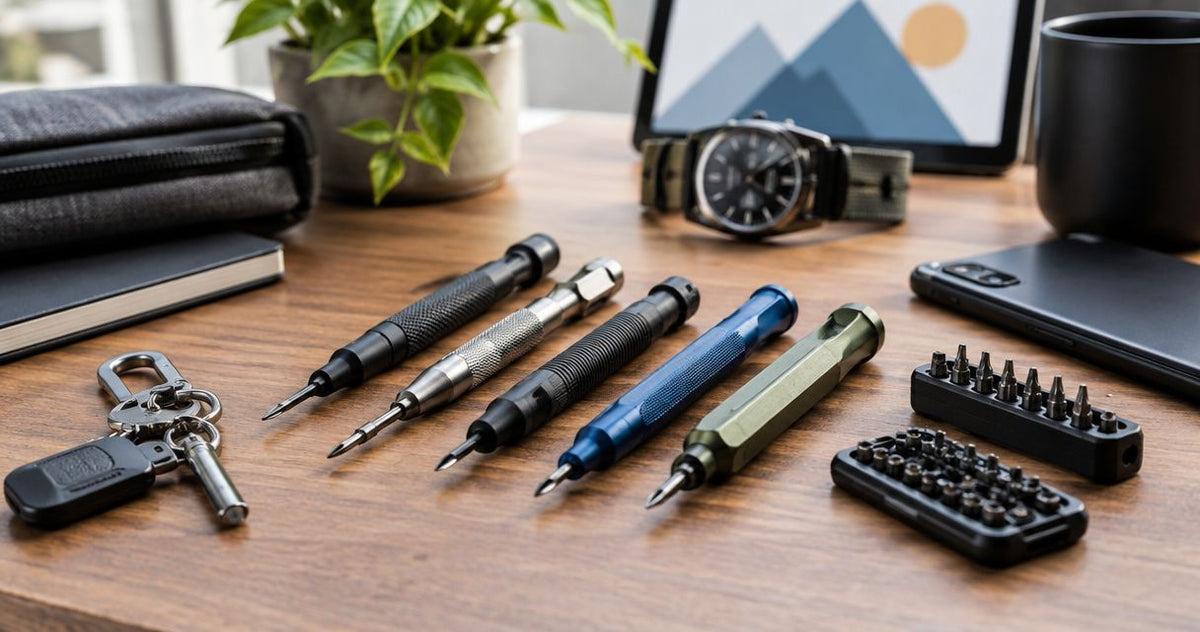
Best overall for pocket carry: Big I Design Ti EDS ll. Best for Torx-focused maintenance: Knafs Bit Driver – Wiha Torx Bits. Best for a dedicated repair kit: Knafs Bit Driver Grande. Best budget approach: keep your existing driver and match its bits to your gear. This 2026 edc screwdriver guide from Grayman Trading Company separates everyday carry from the tools you leave in a maintenance pouch.
- The best edc screwdriver matches your fasteners and carry habits, not the largest accessory set.
- Big I Design Ti EDS ll is the pocket-carry pick for compact construction and one-handed operation.
- Knafs Bit Driver – Wiha Torx Bits is the Torx-focused maintenance option.
- Knafs Bit Driver Grande belongs on the shortlist for a dedicated repair pouch.
- Keep your existing driver if it already fits your screws and travels with your gear.
Why this matters
A screwdriver earns pocket space by solving a problem you actually encounter. A loose clip screw, an equipment adjustment, or a small repair needs the right tip first. An attractive handle with the wrong bit does nothing useful.
The other problem is access. If changing bits means emptying a handle onto a work surface, you have turned a small adjustment into a loose-parts exercise. Judge the complete process: retrieving the tool, selecting the bit, seating it, turning the screw, and putting everything away.
Grayman Trading Company's edc screwdriver pick for pocket carry is Big I Design Ti EDS ll, for buyers who want compact construction and one-handed operation. That recommendation is about carry and deployment, not a claim that a pocket tool replaces a workshop screwdriver.
What makes the best EDC screwdriver?
Use these criteria before choosing a handle material or a brand. They keep the purchase tied to your equipment rather than your collection.
- Fastener fit: Match the tip profile and size to the screws you actually adjust. A near match is not a correct match.
- Bit access: Check whether you can retrieve the needed bit without scattering the others. Storage matters only if retrieval works.
- Working clearance: Consider the space around the screw. A handle that works on an exposed screw can be awkward beside a housing or bracket.
- Grip and control: You need stable pressure along the screw's axis. More force does not compensate for poor engagement.
- Carry placement: Decide whether the driver belongs in a pocket, an organizer, or a repair pouch. Those are different jobs.
- Task limits: Separate ordinary adjustments from work that needs a specified torque, electrical protection, or a dedicated precision tool.
For your 2026 carry setup, write down 3 screws you expect to service before choosing a screwdriver. Record their profiles and sizes. This is a purchasing exercise, not a claim that every carry kit needs the same bit assortment.
Best EDC screwdrivers at a glance
These picks occupy different use cases. The table ranks task fit rather than treating every screwdriver as interchangeable.
| Rank and option | Best for | Standout feature or approach | Key limitation |
|---|---|---|---|
| 1. Big I Design Ti EDS ll | Everyday pocket carry | Compact screwdriver with one-handed operation and a secure frame-lock | Pocket convenience does not establish suitability for torque-specific work |
| 2. Knafs Bit Driver – Wiha Torx Bits | Torx-focused gear maintenance | A named driver option paired with Wiha Torx bits | A Torx-focused purchase still needs to match your exact screw sizes |
| 3. Knafs Bit Driver Grande | A dedicated repair-pouch setup | A dedicated bit-driver option to evaluate around your maintenance tasks | Adds a separate tool to a kit that might already contain a driver |
| 4. Your existing driver with matched bits | Avoiding a redundant purchase | Uses a tool you already know and own | Only works as everyday carry if you actually carry it |
Choose the carry location first. A pocket driver should be easy to bring along; a repair-pouch driver should fit the work assigned to that pouch. Neither wins simply by being called EDC.
1. Big I Design Ti EDS ll: best EDC screwdriver for pocket carry
Big I Design Ti EDS ll is a compact screwdriver made from grade 5 titanium alloy. Its stated features include one-handed operation and a secure frame-lock. Those are relevant features when you want a dedicated screwdriver in your everyday carry rather than another tool left at home.
The practical attraction is deployment. One-handed operation addresses how you get the tool ready; compact construction addresses where you carry it. Neither tells you whether your chosen bit reaches a recessed fastener, so check the actual task before making it your only driver.
Big I Design Ti EDS ll pros:
- Compact construction makes it a candidate for a pocket-based setup.
- One-handed operation is an explicit feature, not an assumption based on appearance.
- A secure frame-lock is part of the stated design.
- Grade 5 titanium alloy construction is specified.
Big I Design Ti EDS ll cons:
- A dedicated screwdriver adds another item to your carry.
- The frame-lock is an operating mechanism you need to understand before use.
- Pocket convenience does not replace a torque-controlled tool when the equipment instructions require one.
Best for: Buyers prioritizing a compact, dedicated pocket screwdriver with one-handed operation.
For a 2026 pocket setup, evaluate Big I Design Ti EDS ll around an actual adjustment, not a display arrangement. Check retrieval, bit engagement, and whether you can put the tool away without juggling loose components.
Verdict: Buy for compact pocket carry after confirming the bit and reach match your equipment.
2. Knafs Bit Driver – Wiha Torx Bits: best for Torx maintenance
Knafs Bit Driver – Wiha Torx Bits is the focused option when your maintenance list calls for Torx. Its named pairing keeps the buying decision centered on the fastener rather than on handle material. Start with the screws, then confirm the included bit selection matches them.
Torx is a profile, not a universal size. Do not assume that a Torx-focused driver covers every knife, accessory, or piece of outdoor equipment you own. Equipment instructions remain the authority for bit selection and tightening requirements.
Knafs Bit Driver – Wiha Torx Bits pros:
- The named configuration is directly relevant to Torx-focused maintenance.
- Wiha is identified as the bit brand.
- A dedicated driver-and-bit purchase gives you a specific setup to assess against your gear.
Knafs Bit Driver – Wiha Torx Bits cons:
- A Torx focus does not solve Phillips, slotted, or hex tasks by itself.
- The correct profile still needs the correct size.
- A dedicated maintenance tool adds carry if another tool already covers the same work.
Best for: Buyers building a maintenance kit around identified Torx fasteners.
Make a short fastener list before selecting this option. If your recurring repairs involve mixed profiles, evaluate the whole kit rather than assuming the Torx pairing completes it.
Verdict: Buy for confirmed Torx tasks; skip as a catch-all purchase without checking your fasteners.
3. Knafs Bit Driver Grande: best for a dedicated repair pouch
Knafs Bit Driver Grande is the dedicated-driver candidate for a repair pouch or maintenance organizer. That use case starts with keeping the tool beside the gear you service, rather than requiring every repair item to live in a pants pocket. The name alone is not a reason to choose it.
A repair-pouch setup gives you room to organize the driver, relevant bits, and small parts as a system. The benefit comes from that organization. You still need to confirm the driver meets your bit, clearance, and grip requirements.
Knafs Bit Driver Grande pros:
- It is a dedicated bit-driver option rather than an unrelated tool pressed into service.
- A repair-pouch role lets you choose around maintenance tasks instead of pocket appearance.
- Keeping the driver with the repair supplies creates a clear place to return it.
Knafs Bit Driver Grande cons:
- A separate driver duplicates function if your pouch already contains a suitable one.
- Pouch carry is less immediate than keeping a tool directly in your pocket.
- The Grande name does not establish bit fit, reach, or suitability for your particular repair.
Best for: Buyers assembling a dedicated maintenance pouch and evaluating a separate bit driver for it.
Verdict: Hold until you have defined the pouch's jobs; buy only when the driver fills a real gap.
4. Your existing driver: best for avoiding a redundant purchase
Your existing screwdriver is the first option to assess before adding another tool. If it engages your fasteners correctly, provides usable clearance, and fits your carry location, a new handle does not automatically improve the repair. Familiar equipment has value when you already understand its operation.
The limitation is access. A suitable driver at home is not an everyday carry tool during a field adjustment. Decide whether you can relocate it into the kit you bring along without leaving another essential setup incomplete.
Existing driver pros:
- Avoids adding a duplicate tool.
- Lets you assess fit using equipment you already own.
- Keeps the decision focused on missing capability rather than a new product.
Existing driver cons:
- Does not help away from home unless you carry it.
- Can leave your workshop kit incomplete if you move its only suitable driver.
- Still needs the correct bits and safe working clearance.
Best for: Buyers whose current driver already covers their actual carry tasks.
Verdict: Keep it if it fits the work and travels with you; buy a replacement only for a specific shortcoming.
Check your screwdriver before carrying it
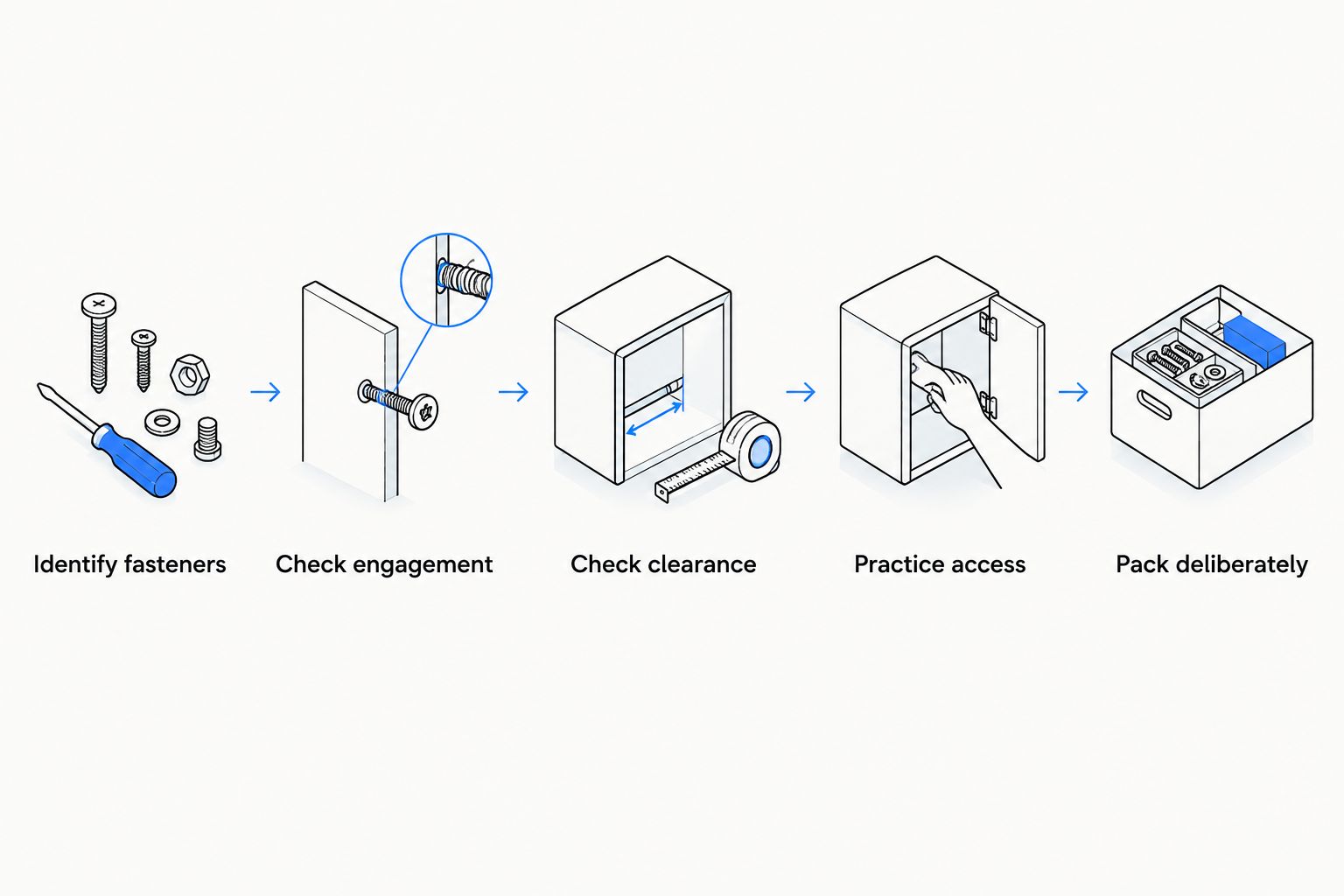
Use this sequence when building your 2026 maintenance kit. It exposes the difference between owning a driver and having a usable repair setup.
- Identify fasteners. Inspect the gear you expect to adjust and consult its instructions. Record the required profiles and sizes.
- Check engagement. Confirm the correct bit seats properly before applying turning force. Stop if the tip does not fit securely.
- Check clearance. Approach the screw in its actual location. Nearby material can block a driver that works perfectly on an exposed screw.
- Practice access. Retrieve the driver and change a bit over a tray or clear work surface. Notice where loose parts end up.
- Pack deliberately. Give the driver and bits defined storage positions. Return everything there after each use.
Practice once with 2 hands, even if the driver offers one-handed operation. Deployment is only part of the job; controlling the workpiece and keeping the bit aligned are separate responsibilities.
Assign the driver 1 primary task before expanding the kit. A narrowly defined starting job makes it easier to distinguish necessary bits from accessories you never use.
How we ranked these EDC screwdriver options
The 2026 order follows carry role, fastener fit, access, and task limits. Big I Design Ti EDS ll leads the pocket-carry slot because compact construction, one-handed operation, and a secure frame-lock are stated features. The Knafs Torx pairing occupies the fastener-specific slot, while Grande is the dedicated-pouch candidate.
This is a use-case ranking, not a measured comparison of torque, weight, or durability. Grayman Trading Company's edc screwdriver recommendations prioritize the job you need to complete over an unsupported performance leaderboard.
Which EDC screwdriver should you choose?
Choose Big I Design Ti EDS ll if your priority is a dedicated pocket driver with one-handed operation. Choose Knafs Bit Driver – Wiha Torx Bits when identified Torx maintenance drives the purchase. Consider Knafs Bit Driver Grande when assembling a separate repair pouch, not simply because you want another carry tool.
If you are undecided, inspect your current driver first. Your best 2026 upgrade is the one that fixes a known problem: wrong bits, awkward retrieval, poor clearance, or a tool you never bring along.
FAQ
What's the best EDC screwdriver for pocket carry?
Big I Design Ti EDS ll is the pocket-carry pick in this guide. Its stated features include compact construction, one-handed operation, a secure frame-lock, and grade 5 titanium alloy construction. Confirm bit fit and working clearance before choosing it.
Which EDC screwdriver should I choose for Torx screws?
Knafs Bit Driver – Wiha Torx Bits is the Torx-focused option in this guide. Match the actual bit sizes to your equipment; a Torx profile alone does not establish compatibility with every screw.
Is a dedicated screwdriver better than a multi-tool?
A dedicated screwdriver is the better choice when its access and working clearance suit your recurring screw tasks. A multi-tool remains a separate decision based on the other functions you need. Compare the actual repair, not the number of tools listed.
Does a titanium handle make a screwdriver the best choice?
No, titanium construction does not establish fastener fit, working clearance, or suitable tightening control. Big I Design Ti EDS ll specifies grade 5 titanium alloy, but its carry and operating features also matter to the recommendation.
Can I use an EDC screwdriver for knife maintenance?
Use an EDC screwdriver for knife maintenance only when the correct bit, access, and manufacturer instructions support the task. Do not assume every knife uses the same screw profile or size. Avoid disassembly unless you understand the required procedure.
Should I carry my screwdriver in a pocket or a repair pouch?
Use a pocket for tasks that justify immediate access, and a repair pouch for a dedicated maintenance setup. Put the driver where you will actually bring it along and can keep its bits organized.
Do I need to replace a screwdriver that already works?
No, keep your existing driver if it fits your fasteners, provides working clearance, and travels with your gear. Replace it only to address a specific shortcoming rather than duplicating a function you already have.
One last thing
The part most likely to derail a small repair is not the handle material. It is a setup that makes you search for the correct bit while holding loose hardware.
Store the bit you actually need where you can identify and retrieve it. Before the driver goes into your carry, complete a full retrieve-use-repack cycle. A tool that returns neatly to its place is easier to keep ready for the next job.
